

Critical minerals sit inside the magnets, batteries, sensors, lasers, and chips that enable modern industry. They function as a quiet dependency beneath the technologies that define modern industry.
For decades, the U.S. bypassed this dependency. The West mined where it was cheap, outsourced processing where it was cheaper, and bought back refined material on demand.
Today, the substantial national security vulnerability created by our outsourcing is finally being recognized. In July 2023 China announced export controls on gallium and germanium. By December of the same year, it had added graphite, and a year later in December 2024, it tightened restrictions on gallium, germanium, antimony, and graphite exports to the United States. The message was obvious; whoever controls end-to-end critical mineral supply chain controls the industrial and defense ecosystems. Midstream processing is a particularly vulnerable dependency. Access or deposits do not automatically deliver minerals resilience and today, China controls more than 90% of processing of essential critical minerals and rare earth elements.
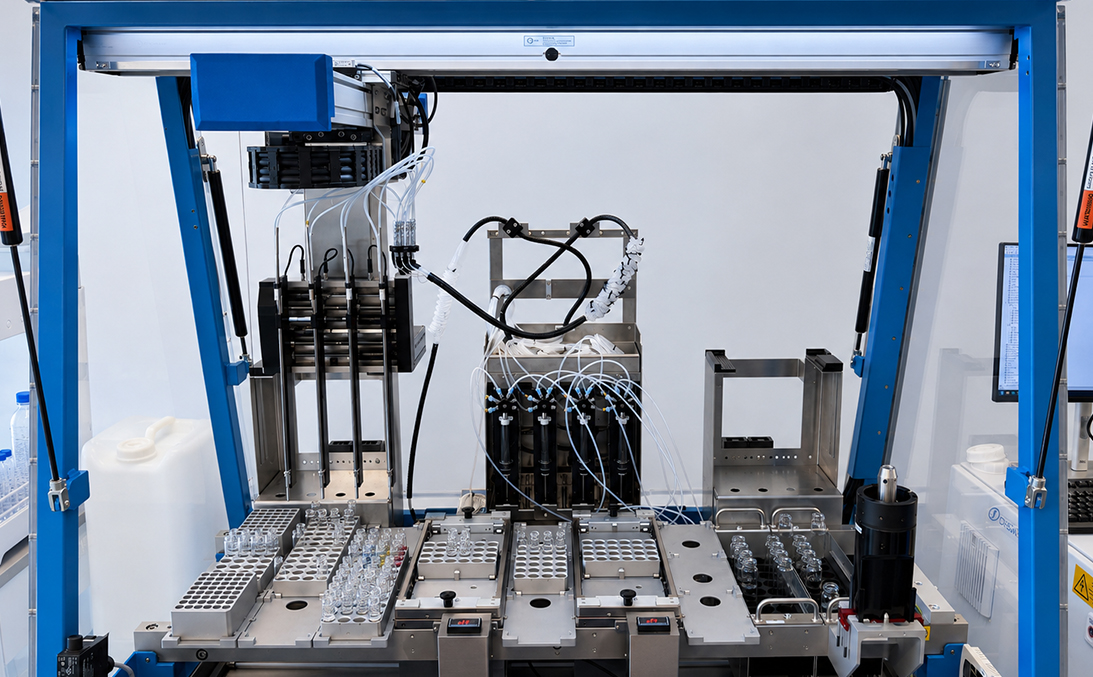
That is why we invested in Riven. Grounded in industrial chemistry, Riven is developing an integrated AI platform for the built world to solve the gating separations bottleneck, turning messy feedstocks into usable material at a fraction of the cost and in a fraction of the time. We believe midstream processing is a strategic constraint.
The key limiter in midstream processing is separation: the chemistry and know-how which convert mixed mineral streams into inputs that a battery plant, magnet maker, semiconductor fab, or defense prime can actually use. This is the layer Riven is attacking.
Why Riven?
Solvent extraction (SX), the workhorse chemistry behind nearly every critical mineral and rare earth element separation, is not a new unlock. It underpins rare earths, copper, cobalt, nickel, lithium, and uranium alike. While much of the foundational chemistry originated in the United States, China spent decades carefully optimizing it, filing tens of thousands of patents and closely guarding process know-how. With China providing an exponentially cheaper alternative, the U.S. remained dependent. As a result, in the West, flowsheet design has remained a sort of static art form, tuned to one ore body at a time, carrying significant cost of capital, years of lead time, and hundreds of manual stages.
Riven changes the game. Riven’s approach is to close the loop and compound learnings from successive processes, leveraging their findings to generalize beyond any single feedstock or element. Rare earths are the beachhead, where the chemistry poses the greatest challenge and the strategic need is most acute. However, the same engine will apply wherever two elements must be pulled apart, enabling critical mineral separation at scale to ensure the U.S. can separate and process essential material inputs onshore, now.
The Team
We believe in the real and growing need for a platform like Riven, and we see co-founders determined to deliver it in CEO Chip Breitenkamp and CTO Orion Archer Cohen.
Chip is a PhD chemist and former President of NanoGraf, a battery materials manufacturer, but what stands out most is that he has lived the hard part of materials commercialization. He has seen promising chemistry interact with input variability, equipment constraints, plant economics, and the countless details that determine whether and how a process can scale. That lived experience is essential when working on infrastructure deeply embedded within decades-old pain points, processes, and techniques. Chip understands that bringing something to the application layer of the built world requires translating proven theory from the lab into execution and workflows at the plant.
Orion brings the computational depth needed to make that learning loop scale. He holds a PhD in chemistry from UC Berkeley, was an NSF Fellow at Lawrence Berkeley National Laboratory, contributed to the Materials Project, and led development of TorchSim, a core open-source tool for AI-accelerated atomistic simulation built with NVIDIA. His background sits directly at the intersection Riven depends on: rigorous chemistry, modern simulation infrastructure, and AI systems that improve as data compounds.
We’ve found Chip, Orion, and the rest of the Riven team’s practical approach to the separation bottleneck incredibly refreshing. They are not treating critical minerals as a simple software problem or relying on abstract promises of AI. They are building from the realities of chemistry, feedstock variability, and plant-level execution, while harnessing the most advanced software to make each experiment and process improvement compound. That combination is what gives us conviction. We believe Riven has the potential to help rebuild a missing layer of Western industrial capacity and turn the persistent domestic bottleneck of midstream processing into a durable advantage.
Final Thoughts
The critical minerals problem will not be solved by a single mine, a single plant, or a single technology. Riven takes that view and is already working tirelessly to build the intelligence layer that lets a new generation of Western processing capacity come online faster, cheaper, and closer to the feedstock it serves, across the full set of materials the next decades will run on.
The Riven team is growing. Visit their website to learn more.


Suggested Reads